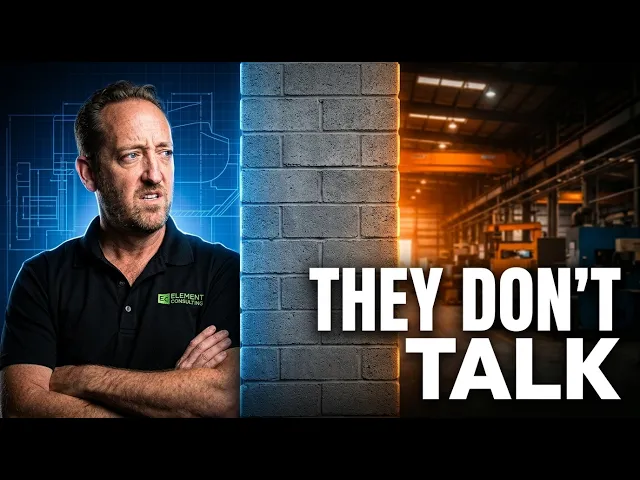
The Grenade Over the Wall: Why Manufacturing Dreads Your Design Release
Process & People


Eric Horn
Managing Partner
Some deliveries feel like a birthday present. Most feel like somebody lobbed a grenade over the wall.
There’s a comfortable theory about how product development works. Engineering designs it. Manufacturing builds it. The handoff is clean because the design is self-explanatory.
Ask anyone who’s worked a shop floor how often a design release arrives requiring no questions, no comments, no concerns, and no revisions. The honest answer is somewhere between “rarely” and “never.”
Tossing designs over the wall works beautifully — if you’re so good at designing for manufacturing that you never need to talk to manufacturing. Nobody is.
Watch the face
Here’s the fastest diagnostic I know for how healthy an engineering–manufacturing relationship is: watch what happens when a release lands.
Nobody’s excited to open the package. They’re scanning it for the ticking part. What’s in here that’s going to eat my next three weeks? Which of these parts can we actually not produce?
“You look first.” “No, you look.”
That’s the tell. And it’s worth naming who’s in that room: the receiver of the handoff feels the pain first and has the least power to prevent it. They inherit decisions that were finalized before anyone asked them a question — and then they’re the ones who have to raise their hand and be the bad news. They’re also, in most organizations, the last people anyone thinks to consult.
I was the guy throwing them
I want to be fair here, because I’ve been on the other side.
Early in my career I designed what I was certain was the greatest toaster ever made. Sent the drawing to manufacturing fully expecting applause.
What came back: “We can’t make these parts.”
I was genuinely indignant. You don’t have an eight-axis mill that produces whatever I imagine? They did not. They offered 3D printing as an alternative — and then pointed out the obvious problem, which is that you cannot 3D print a material that survives the heat requirements of a toaster.
So back to the drawing board, redesigning parts that never needed redesigning.
Here’s what I actually got wrong, and it wasn’t the geometry: I never asked what the plant could build. I didn’t know what our manufacturing capabilities were, and I hadn’t thought to find out. Not because I was careless — because nobody had ever put me in a room with the people who had to make it.
Twenty years later, I see the same pattern constantly. It is almost never a bad engineer. It’s an organization that never created the conversation.
It runs both directions
The obvious fix is that engineers should understand manufacturing capabilities. True, and incomplete. The more interesting flow runs the other way.
When manufacturing says “we’re evaluating an investment in this new capability — what do you think?”, that engineer should absolutely be in the conversation. Because the answer might be: that would be excellent, here’s what I could design if we had it, here’s what it unlocks in the next product.
Now your capital investment is informed by what engineering wants to build, and engineering is designing toward capability you’re about to have. That’s a fundamentally different company than one where manufacturing buys equipment in isolation and engineering finds out later.
If customers want flame-grilled burgers and you have a flat top, somebody should have had that conversation before the orders came in.
Yes, some of this is unavoidable
I want to be careful not to oversell the fix.
Some rework is structural. We make assumptions. We think we know best. And genuinely, sometimes you don’t know until you try — manufacturing can give you their best estimate, but nobody knows the full picture until they start cutting chips off a piece of metal and learn something the model couldn’t tell them. That’s fine. That’s engineering.
The goal isn’t zero surprises. It’s maximizing how much knowledge you have up front, so the surprises left are the ones that genuinely required doing the work to discover — not the ones a fifteen-minute conversation would have prevented.
Are your silos actually coming down?
Most manufacturers I work with will tell you they’re breaking down silos. Roughly half genuinely are.
The other half have reorganized the silos. Different structure, same isolation, sometimes worse because everyone now believes the problem is solved. There are still decisions being made without consulting the people affected, and there are still changes being written afterward to fix them.
The test isn’t the org chart. It’s whether manufacturing is in the design review before the design is finished — and whether their objections can actually change the outcome at that point, or just get logged.
If manufacturing is in the room but the design is already frozen, you haven’t broken down a silo. You’ve added a meeting.
The short version
If your design releases require no questions or revisions, you’re the rare exception. Nobody is.
The receiver of the handoff feels the pain first and has the least power to prevent it.
Most “bad handoffs” come from engineers who were never given access to manufacturing knowledge — not carelessness.
The conversation matters in both directions; manufacturing capability decisions should include engineering.
Some rework is unavoidable. The goal is eliminating the preventable kind.
Breaking down silos means manufacturing can still change the design when they raise a concern.
If you’re on the receiving end of that handoff: what’s the one thing you wish engineering asked you before release? That question, asked out loud, is usually where this work starts.
Element Consulting has completed 127 PLM implementations connecting engineering and manufacturing in aerospace & defense, medical device, automotive, and industrial equipment. Related reading: What is MPMLink, eBOM vs. mBOM, and the engineering change order process guide. Talk to a Windchill expert →
About the author
Eric Horn
Eric Horn is Managing Partner at Element Consulting and a PTC Certified Windchill Implementation Practitioner with 20+ years in PLM across aerospace, industrial, and medical.